Chromotherapy


There are two definitions of chromotherapy, which is also called colorology or color therapy. The first says it is a method of alternative medicine that uses color and light to balance energy where it is lacking in the person’s body. The other says it is a “science that uses the colors to modify or keep the vibrations of the body with a frequency that results in health, welfare and harmony.”

Based on these concepts, the use of color and light is an integral part of chromotherapy as a method of alternative medicine. Persian physician and philosopher-scientist Avicenna once wrote in the book Canon of Medicine that color is an observable symptom of a disease and said that wrong color would not draw any response in a certain disease. He cited an example of a person with a nosebleed who should not be allowed to gaze at a brilliant red color to prevent stimulating blood flow but at a blue color to soothe the nosebleed. Present-day chromotherapists agree with the view of Avicenna that red would move the blood, while the blue or white, which is the perfect color, would cool the blood flow.

The meaning of each color in chromotherapy is related to the physical condition and temperature of the body. Most charts adopted by chromotherapists indicate that red activates the circulation while blue serves as analgesic but regenerates muscle cells and nerves. Dr. Edwin Babbitt, one of the most influential American writers on color therapy in the 19th century wrote that “blue is one of the great antiseptics in the world.” While pink eliminates blood impurities, a strong pink can act as a cleaner and strengthen the veins and arteries. Violet is said to also relax the nerves and heals infections and inflammations, and resolves urinary problems. Strong green is anti-infectious and cell-regenerative. In some color charts, orange is an energizer and yellow a reactivator, purifier and a skin rejuvenator. While strong yellow strengthens the body, the green cleans and serves as a nerve relaxant. Indigo is said to purify the circulatory system and can treat eye inflammations, cataract, glaucoma and fatigue. 

Chromotherapy is performed with the use of the Luscher’s color test as a diagnostic tool developed by Dr. Max Luscher, a renowned Swiss pioneer in color psychology, in the early 20th century. Following this test, color and light are then applied to the patient’s pressure points and specific area in the body. The tools used in the application of colors include gemstones, candles, wands, prisms, lenses, and fabrics, among others. Treating a patient involves the use of a lamp and a colored filter. In this method, the colored light is directed to the affected area. An accurate amount of color is necessary and critical for healing as is the specific color for the specific ailment. The physical body of the patient is said to heal faster if it is exposed directly to the colored light, which stimulates and rehabilitates the balance in the affected area of the body.

Some practitioners have issued some precautions and reminders related to the practice of chromotherapy. These are (a) Excesses in time of exposure to the colored light are harmful to the patient, (b) Application of color in the wrong area can cause unwanted results, (c) Colors are not simply applied to the body, and (d) The very persons who should have the legal responsibility in caring for the patient are the doctors, psychologists, health professionals, and massage therapists.

Quinton Method


Rene Quinton is a French biologist who was the first to investigate the similarity between sea water and the human blood plasma system. He carried out several scientific experiments in hospital laboratories in an effort to solve what he considered as the mysteries of sea water, and find out if it was compatible with living organisms. Assured that ocean water is very similar to human blood and is injectable and even drinkable, Quinton developed the Ocean Plasma, otherwise known as Quinton Plasma or Quinton Method, which is said to have the therapeutic properties of sea water in both diluted and undiluted formulas. These formulas are said to be one of the greatest innovations in medicine in the 20th century.

Called Quinton Isotonic and Quinton Hypertonic, the formulas in product forms have undergone processing and a series of controls in the laboratory, including checks of the sea water’s physical, chemical and microbiological characteristics or properties. The Isotonic formula is made by diluting or mixing the sea water with pure spring water. The Hypertonic formula is produced through a process that does require admixing the sea water with spring water. The sea water used in the formulas is taken from unpolluted locations in the sea, usually between 10 meters from the bottom and 30 meters from the surface. This is a location known for its exceptional purity. Before being released to the market, the formulas are processed in the sterile environment in the laboratory, are sampled, analyzed and approved.

The Quinton Isotonic, like the Quinton Hypertonic, is compatible with a physician’s prescription and over-the-counter drugs. Both formulas can also restore or reestablish a patient’s poise and so-called biological equilibrium. Specifically, the Isotonic is applicable for all ages but is recommended for people aged 50 years and above. The Quinton Hypertonic is believed to be ideal for athletes and other persons who may try to recover energy and health. Another formula known as the Quinton Isotonic Nasal Spray, acts as cleaner, moisturizer and stabilizer. It clears not only nasal but also ear obstructions. It can also be used by women to moisturize and soften the skin after removing their facial makeup. It can also treat itching or sun-damaged skin, or that which is infected with fungus or acne. For infants, it can protect them from diaper rash.

The Quinton or Ocean Water Plasma has many uses for human health. It serves as a regenerator and best support for the following cases: (a) Pre-natal care, (b) Infant care, (c) Obstetrics, (d) Pediatrics, (e) Gynecology, (f) Periodontal disease, (g) Gastro-enterology, (h) Respiratory problems, (i) Bone and joint disease, (j) Endocrinology, (k) Urology, (l) Colon therapy, (m) Geriatrics, and (n) Intravenous feeding. For athletic training, the hypertonic solution can be taken as a supplement to promote or boost endurance. Different dosages are recommended for regular training, for the period of competition, and after the competition.

Alexander Technique


The Alexander Technique is a method (a) that works in changing movements or habits in one’s daily activities, (b) that helps an individual discover how to release unnecessary tension in the body, (c) that improves ease, balance, and freedom of movement, (d) that releases unwanted tension in the muscles that may have accumulated over the years, and (e) that helps a person lose the harmful habits built up over years of stressful living. On the basis of these functions, the method therefore tells one how to get rid of harmful tension in the body, and how to use an appropriate amount of effort for a specific activity. It also gives one a way to feel better and to move relaxed and comfortably.

As a method, it is named after Australian actor Frederick Matthias Alexander, who is responsible for developing its principles originally aimed at alleviating breathing problems. The technique is not taught in many parts of the world in half-hour to one-hour sessions. The aim is to make more people gain awareness and learn a skill for application to any activity.

Who are the people who need the Alexander Technique most? Experts say they are (a) Those who suffer from repetitive strain injury, (b) Those who suffer from backache, stiff neck and shoulder pain, (c) Those who feel discomfort when sitting for long hours in front of a computer or television set, and (d) Those who feel they are performing way below their full potential, including singers, musicians, actors, dancers and athletes. With the technique, they are expected to resolve some problems related to poor posture such as lack of concentration, general fatigue, irritability, headaches, back and neck pain, and tense shoulders. Those in sedentary lifestyle are also expected to be relieved of such related problems as poor eyesight, or eyesight deterioration.

The technique can be applied by a person on whatever he does, or when he is sitting, standing, lifting something, walking, or using the computer. This will stop stress and headache, and provide relief to chronic back and neck tension, among its important benefits. To apply the technique, one must follow some of the tension-relieving tips, such as (a) Pausing and breathing fully, (b) Becoming aware and releasing the muscles in the back of the neck, (c) Moving up the head, (d) Lowering one’s nose slightly and slowly, (e) Letting the jaw dangle or hang freely with lips closed, (f) Letting your throat open as if to utter the word ‘ah,’ (g) Letting your shoulders rest on your ribcage, (h) Making your knees get away from each other and away from your torso, (i) Squeezing your legs together and releasing the muscles of your thigh, (j) Thinking of something funny or pleasant and making a natural smile, and (k) Allowing yourself to breathe out fully and your torso to contract as you exhale, and expand as you inhale.

If taught in private sessions, the technique can make students gain awareness and learn a skill useful in any activity. In these sessions, the teacher can use manipulations gently to create a balanced state in the students, and guide them how to sustain their balanced state and prevent their harmful habits at the same time.

NLP: Neuro-linguistic Programming


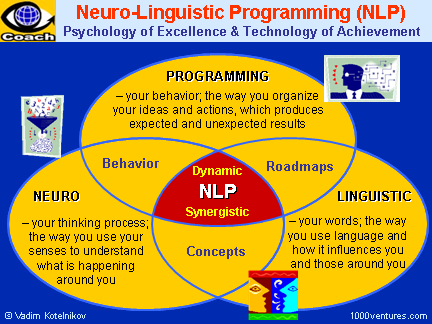
The Neurolinguistic Programming (NLP) was founded in the 1970s as an approach to communication, personal development and psychotherapy or the treatment of mental or emotional disorder. Its founders Richard Bandler and John Grinder have said that NLP refers to the connection between the person’s neurological processes and language and behavioral patterns he has acquired through experience.

Uses and goals. The NLP has therapeutic focus and goals because its early models were psychotherapists themselves. They used it as an adjunct in the practice of other therapeutic fields, or as a specific therapy called neuro-linguistic psychotherapy. But outside psychotherapy, NLP is adopted for use in interpersonal communications, including business communication, management training, interpersonal influence, team building, sales, sports, negotiations and public speaking.

What NLP can do. Bandler and Grinder say that NLP can address such problems as phobias or fears of a particular object, depression, habit disorders, learning disorders, and psychosomatic illnesses or the illnesses that have bodily symptoms caused by emotional or mental disturbances. They also say it can help some people attain life that is fuller and richer. A student of NLP can expect more success in life and attain greater satisfaction in his undertakings. NLP can also make a student acquire a solid foundation for integrating the latest technology into his career. More importantly, knowledge of NLP will enable the student, or any person for this matter, to have a chance to totally change his life for the better, and learn how to be what he intends to be.

NLP teaching. Since its founding in 1970, NLP has been taught in different forms, formats, styles and course lengths. The styles and course lengths for its study usually vary from one institution or organization to the other. At the end of each course, a student is awarded a certificate of completion. In Europe, the length of NLPO training also varies. For the ‘hobbyist,’ the length is two to three days, and 35 to 40 days to nine months for those who want to achieve a level of competence enjoyed by professional psychotherapists.

Trainings , seminars. Many organizations compete for NLP training and certification. Aside from various forms of training, they conduct seminars and workshops, as well as audio programs intended to influence change in behavior and emotions of participants themselves and others. In California, certain organizations offer training seminars leading to certificates for Accredited NLP Practitioner, Master NLP Practitioner, and Trainer’s Training certificate. An online NLP Practitioner Certificate program is also offered for those who do not have the time to be physically present in training institutions.

Criticisms. Some psychologists describe NLP as pseudo-scientific because of its reportedly scientifically groundless claims, terminologies and concepts. NLP, in a related research, is said to appear in a list of discredited psychological occurrences. Furthermore, the “neuro” in the term neurolinguistic is alleged to be effectively deceitful and NLP as a whole is a fake title itself which is designed only to gain scientific attention.

Ayurveda: Indian Medicine

According to David Frawley, an American-Hindu writer and author, Ayurveda is a medicine of nature and of life.” Coming from the Sanskrit words ayur or life or longevity and veda or knowledge or wisdom, it is described as a system of healing that tends to help a patient to harmonize his mind, body and even his lifestyles with the purpose of his spirit. Authorities say that Ayurveda started as a medical practice in India during the middle of the second millennium BCE (Before the Christian Era). Some literatures about the medical practice are found in SasrutaSamhita and CharakaSamhita, two of India’s encyclopedic compilations of literature from various sources. Into the following centuries, several medicinal preparations and procedures for surgery were developed for the ayurvedic treatment of a variety of ailments.

Currently in India, about 80% of its population still uses Ayurveda and other traditional and alternative medicines to treat various diseases. The Indian Medical Central Act had been passed by the country’s Parliamenf only to standardize the qualifications for the practice of Ayurveda and to accredit institutions undertaking ayurvedic study and research. Degree courses in traditional ayurvedic medicine are now offered in some 100 colleges in the country. In many urban and rural areas, too, are numerous Ayurveda clinics run by qualified practitioners and professionals. In addition, the Central Council for Research on Ayurveda and Siddha has been established to conduct Ayurveda research throughout India. It is also tasked to conduct systematic review of ayurvedic treatments for various ailments and find what herbs are helpful for such treatments. 

Ayurveda has gone beyond being a traditional or alternative medicine in India. Like the regular medicine, it uses diagnostic techniques for determining conditions of the body and the imbalances in a person’s energies which are called locally as doshas. These techniques include the diagnosis for the pulse, tongue, face, nails, lips, eye, and the techniques for palpation, or examination by touch, percussion or tapping of the surface of a part of the body to know its condition underneath. Auscultation or listening to the sounds in the organs is another technique for the examination of the heart, liver, kidney, spleen, stool, urine, speech, sweat and the sputum.

Ayurveda practitioners say that digestion is the cornerstone of a person’s health, and that good digestion result mainly from eating proper foods. These foods are classified as physical and those consumed through the mind. The physical foods refer to those which one eats, digests or assimilates or absorbs into the body system. The foods for the mind and body are those that one sees, hears, tastes, smells and thinks. They say that all these foods are important for the person’s well-being because they can influence his health to a considerable extent.

Both types of Ayurveda – the traditional and Maharishi – prescribe herbs for the treatment of a disease, and believe that any disease results from the imbalance in the person’s doshasor energies, aside from poor digestion. These energies are the vata that controls the functions of the body; the pitta that controls the metabolic system of the body; and the kapha that controls the growth in, and supplies water to all parts of the body.


spanishfitness © 2012 | Designed by Cheap Hair Accessories

Thanks to: Sovast Extensions Wholesale, Sovast Accessories Wholesale and Sovast Hair